Wholesale Operations for Shopify: How to Run B2B Without App-Stacking (2026)
Stop patching forms, pricing, credit, and invoices across disconnected apps.
Most Shopify stores begin wholesale by emailing spreadsheets, manually tagging customers, and creating draft orders one at a time. That works for five buyers—not fifty.
This guide is the hub for running wholesale operations on Shopify in 2026: onboarding buyers, enforcing warehouse rules, extending credit, issuing invoices, and giving buyers a self-service portal—on the same storefront your retail customers already use. Deep topics (shipping, PO import, collections, deposits, Shelf Radar, API) live in linked guides so this page stays readable.
We’ll compare Shopify Native B2B (2026) with a dedicated wholesale operations app (Wholesale Engine), walk the end-to-end workflow, and point you to the right deep dive when you need detail.
Who this guide is for
- Merchants outgrowing email + PDF + manual draft orders
- Brands that want one catalog for retail and wholesale (different prices, different checkout rules)
- Teams evaluating a Shopify wholesale app or Shopify B2B app without rebuilding on a separate portal
- Operators who care about Net terms, case packs, and receivables—not just a discount code
April 2026 update: Shopify moved foundational B2B—companies, catalogs, quantity rules, and Net payment terms—onto Basic, Grow, and Advanced, not only Plus. You no longer need Plus (or an app) just to offer Net 30.
When Shopify Plus still matters: deeper company hierarchies, multi-location catalogs at scale, deposits alongside Net Terms, and some enterprise checkout customizations. Most wholesale apps—including Wholesale Engine—use one ledger per approved buyer login, not full Plus company structure.
Shopify Native B2B (2026) vs. Wholesale Engine
Many merchants still assume wholesale requires Shopify Plus. As of April 2026, Shopify Native B2B on paid plans includes company profiles, up to three catalogs, volume/quantity rules, and Net 7–90 payment terms.
That is a strong foundation. What native B2B still does not fully solve for many growing brands:
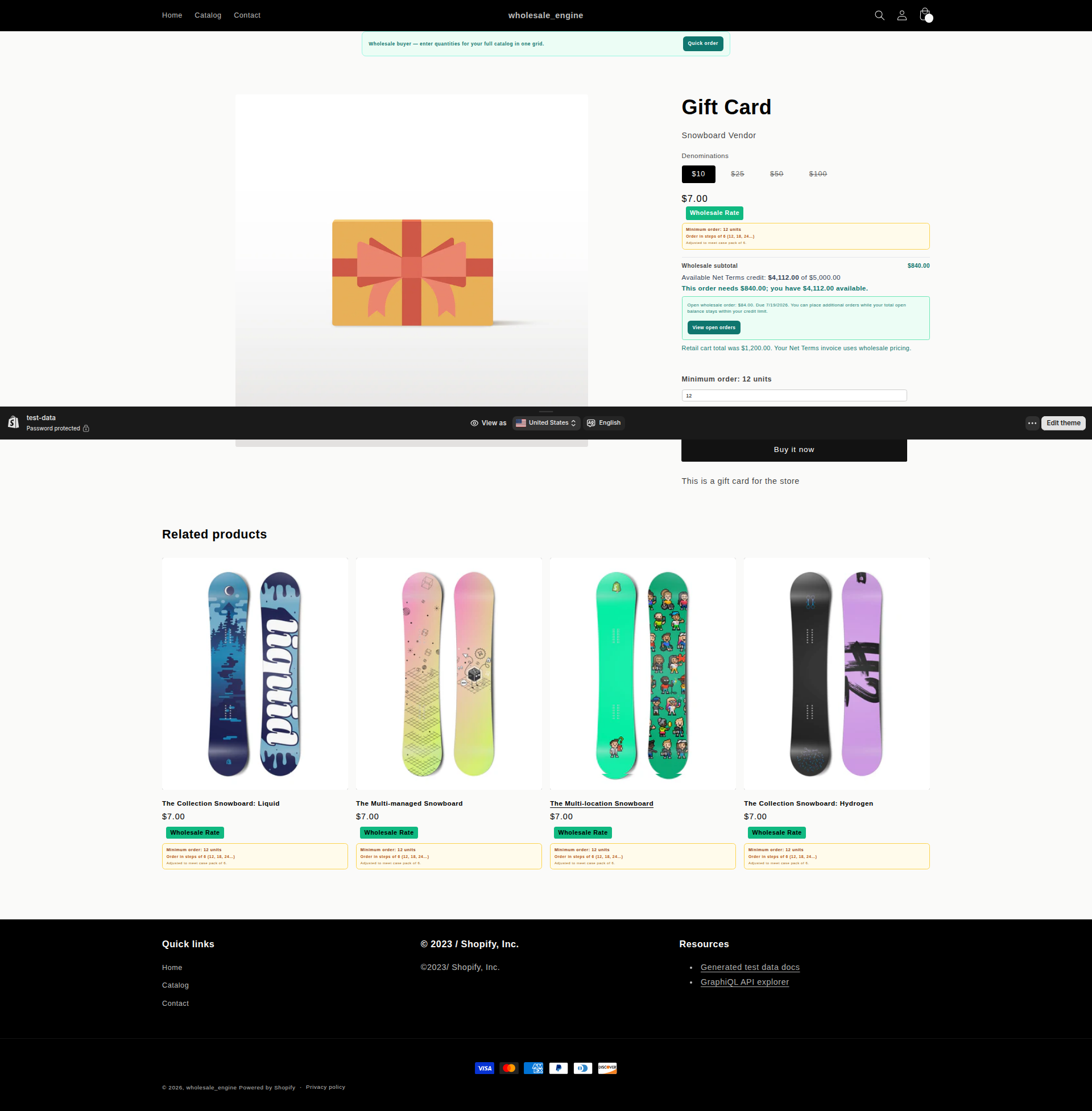
- Credit limits that block checkout when open invoices + cart would exceed the limit
- Overdue freezes so a past-due stockist cannot keep ordering on credit
- A buyer-facing ledger / statements portal for “what do we still owe?”
- Messy PO import (Excel / PDF / email) into a reviewable cart
- Freight held until the warehouse knows the real shipping cost
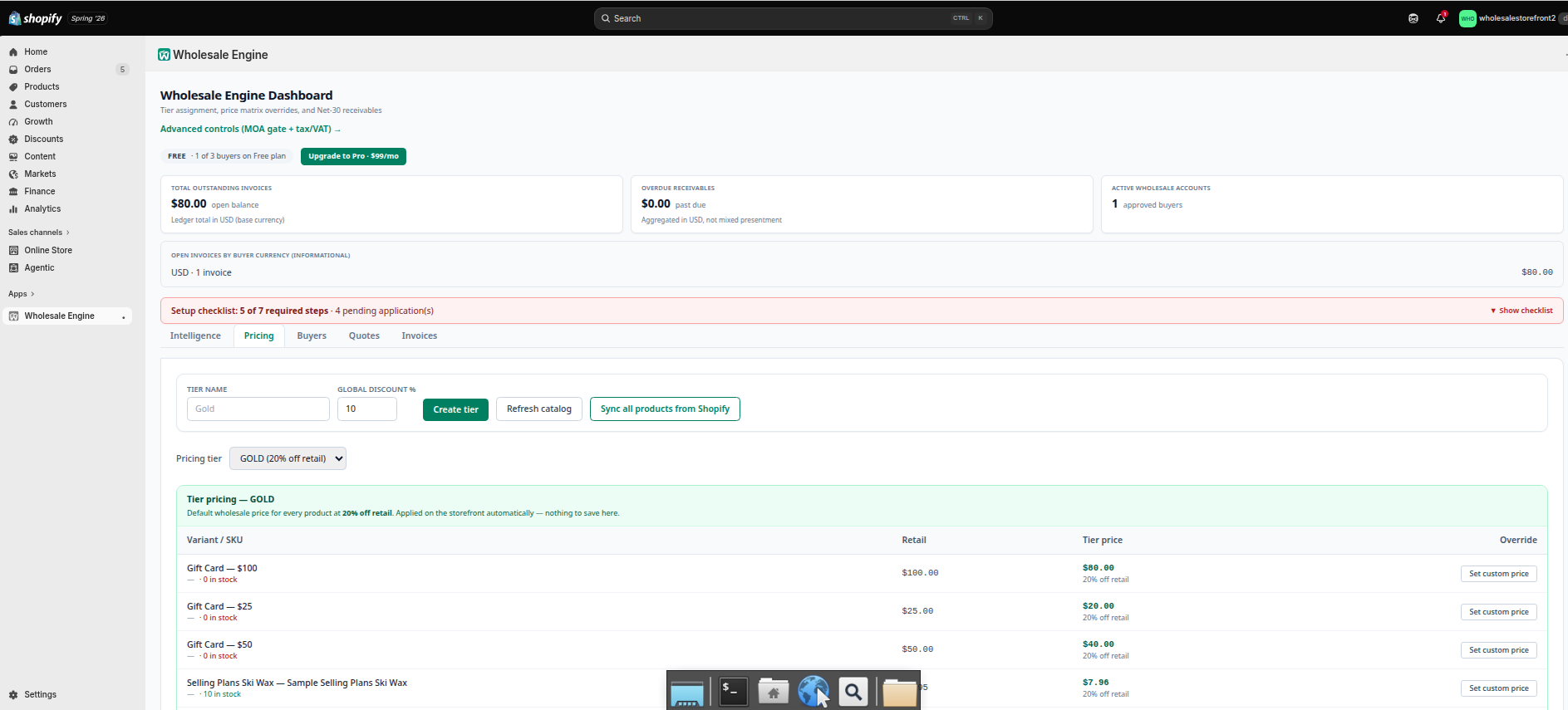
Wholesale Engine is the ops layer for that work: storefront applications, credit pools, case packs, invoice ledgers, buyer statements, shipping treatment, milestone deposits, PO import, Collections Manager, Developer API, Shelf Radar, and a wholesale portal—without stacking five single-purpose apps.
| Capability | Shopify Native B2B (2026) | Wholesale Engine | |------------|---------------------------|------------------| | Company profiles + catalogs + quantity rules | ✅ On paid plans (limits apply) | ✅ (app buyer model) | | Net payment terms (Net 7–90) | ✅ On paid plans | ✅ | | Show wholesale prices to approved buyers | ✅ Via catalogs | ✅ Tiers / matrix / contract | | Same storefront for retail + wholesale | ✅ | ✅ | | Company locations & shared corporate credit | Stronger on Plus | ❌ One login = one ledger | | Credit limit enforced at checkout | ❌ Not native | ✅ Credit pool | | Block overdue buyers from ordering | ❌ Manual process | ✅ Overdue freeze | | Buyer document upload (in-app) | Limited | ✅ Optional certs on apply | | Tax ID format auto-approval (merchant toggle) | ❌ | ✅ Syntax check only—you still approve | | Case-pack multiples (warehouse pack sizes) | Via configuration / apps | ✅ Per-SKU + checkout block | | Receivables ledger & mark paid | Basic / external | ✅ With Shopify order sync | | Automated overdue reminder ladder | ❌ | ✅ Pro Collections Manager | | Buyer self-service portal & A/R statements | Limited | ✅ Enhanced | | PO import (CSV / Excel / PDF) | ❌ | ✅ Review cart + SKU alias learning | | Net Terms shipping gate + freight finalize | Manual drafts | ✅ Hold invoice until freight / free / pickup / collect | | Milestone deposits (e.g. 25/75) | Plus for native deposits; else manual | ✅ Deposit now; balance + freight after production | | Developer API (buyers + webhooks → accounting) | Limited | ✅ v1 bearer tokens + `wholesale_invoice_paid` | | Shelf Radar (stockist lookalikes) | ❌ | ✅ Included with Pro |
Positioning in one line: Shopify now gives you native B2B plumbing on every paid plan. Wholesale Engine gives you wholesale operations—credit, collections, POs, and freight—after Net Terms alone stop being enough.
Deep dive: Shopify Net Terms in 2026: what native gives you — and what it still doesn’t.
Wholesale is operations, not discounts
Most merchants think wholesale starts with discounts. It doesn’t.
Running wholesale also means approving buyers, collecting documents, assigning prices, extending credit, issuing invoices, finalizing freight, collecting deposits when production can’t wait, restoring credit when paid, giving buyers statements, and optionally pushing settled invoices into your books.
That’s the moat—not “10% off Gold tier,” but running the business.
The wholesale workflow (end to end)
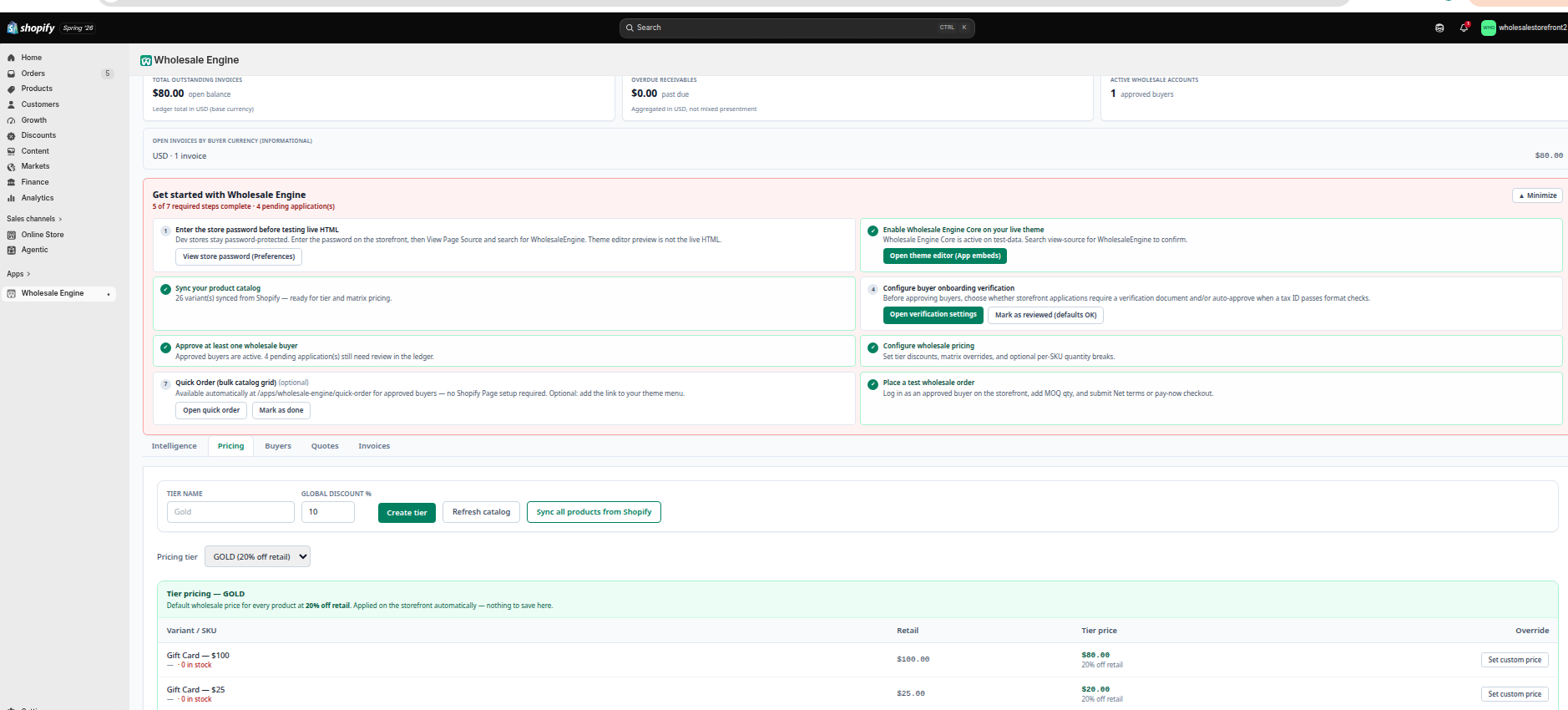
1. Buyer applies on the storefront (optional document upload). 2. Merchant approves — no wholesale prices until then. 3. Pricing + warehouse rules — tiers/matrix, MOQ, case-pack multiples on PDP and cart. 4. Order — Quick Order grid or PO import → Net Terms / pay-now with credit check. 5. Invoice — Shopify draft + ledger row; optional deposit; shipping treatment before the full total goes out. 6. Fulfill & collect — optional auto-convert; buyer portal for open balance; mark paid restores credit. 7. Books (optional) — Developer API webhooks into your accounting stack.
Credit loop in practice (intelligence → invoices → overdue freeze → buyer portal → mark paid):
<!-- EMBED:net-terms-credit-demo -->
Related guides (deep dives)
| Guide | When to read it | |-------|-----------------| | Shopify Net Terms 2026: native vs credit | You turned on native Net Terms and still need credit limits / overdue blocks | | B2B accounts receivable without Plus | Credit, invoices, overdue holds, and buyer statements still live in spreadsheets | | Net Terms risk calculator | You want a rough dollar read on bad debt + AR admin before you change process | | Net Terms shipping & freight | Invoices go out before freight is known | | Intelligent PO import | Buyers still email CSV / Excel / PDF POs | | Collections Manager | Overdue follow-up is still a spreadsheet | | Milestone deposits | Production needs cash before full payment | | Shelf Radar | You need lookalike stockists, not a stale lead list | | Developer API & webhooks | Finance needs paid invoices in your ERP |
Onboarding, case packs, Net Terms credit, and the buyer portal are covered enough above for a first install—those deep dives add shipping, import, collections, deposits, prospecting, and integrations when you’re ready.
Wholesale Engine pricing: Free, Starter, Growth, and Pro
| Plan | Price | Approved wholesale buyers | Best for | |------|-------|----------------------------|----------| | Free | $0 | Up to 3 | Testing pricing, checkout, and live orders with a few accounts | | Starter | $12/month | Up to 10 | Past trial — a handful of stockists without paying for 25 seats | | Growth | $25/month | Up to 25 | Growing brands that need more headroom without unlimited scale | | Pro Unlimited | $99/month | Unlimited | Unlimited buyers + credit automation, Collections Manager, and Shelf Radar |
All Free / Starter / Growth plans include the same core manual wholesale workflow. Paid plans only raise the approved-buyer cap until Pro. Collections Manager, credit-monitoring automation, and Shelf Radar are Pro-only.
If a merchant downgrades below their current buyer count, existing approved buyers remain approved. The app blocks new approvals until the account is back under the plan limit.
Common mistakes
1. Letting wholesale buyers hit retail checkout — block “Buy it now”; enable checkout validation for tagged buyers. 2. Approving buyers before pricing is ready — map tiers and matrix first; test on Free (3 buyers). 3. MOQ without case packs — warehouse pack sizes need modulus rules, not just a floor. 4. Sending Net Terms invoices before freight is known — use the shipping treatment gate. 5. Expecting Plus-style multi-location B2B from any app — one login = one credit line unless you’re on Plus company architecture. 6. Re-keying PO spreadsheets by hand — use PO import + Quick Order.
FAQ
Can I run a Shopify wholesale program without Shopify Plus? Yes. As of April 2026, native B2B (companies, catalogs, Net Terms) is on Basic, Grow, and Advanced with plan limits. Many merchants still add a wholesale operations app when they need credit enforcement, case packs, PO import, or a buyer A/R portal.
Do I need a second Shopify store for wholesale? No. One store can serve retail guests and approved wholesale buyers.
How much does Wholesale Engine cost? Free (3 buyers), Starter $12/mo (10), Growth $25/mo (25), Pro Unlimited $99/mo (unlimited + Collections Manager and Shelf Radar).
What does Pro add beyond more buyers? Credit-monitoring automation, Collections Manager, and Shelf Radar. Free / Starter / Growth keep the full manual receivables path.
When should I upgrade to Shopify Plus? When you need native company locations, shared corporate accounts, or enterprise procurement—not because basic wholesale pricing requires Plus in 2026.
Will retail customers see wholesale prices? No—access is gated until you approve the buyer.
Run wholesale operations on Shopify—not another app stack
Wholesale Engine is wholesale operations for Shopify: onboarding, pricing, credit, invoices, shipping treatment, deposits, PO import, portal, Collections Manager, Developer API, and Shelf Radar—in one embedded app.
- Free: up to 3 approved wholesale buyers
- Starter — $12/month: up to 10
- Growth — $25/month: up to 25
- Pro Unlimited — $99/month: unlimited + Collections Manager + Shelf Radar
Install Wholesale Engine on Shopify →
See Wholesale Engine in action